

Mapping tension
Part 3 of 8 on the revision process

The narrative arc
Now that you’ve completed that scene-by-scene outline, it’s time to move to the next step in the review and evaluation of your first draft, all in preparation for identifying and making any necessary revisions.
The narrative arc is another form of an outline, but it serves a distinct purpose. No need to create an entirely new outline though. You can use your existing scene-by-scene outline to map it out, probably just by adding a line between scenes to note where each step in the arc falls.
You’ll use this layer to analyze the rise and fall of your story’s tension.
Here’s a link to an earlier piece that goes into more detail on what a narrative arc is, so if you’re unsure or need a refresher, go back and read (or reread) this first.
We’ll build onto your scene-by-scene outline by layering on the sections of the eight-point narrative arc.
Map your scenes onto the arc
Review your scene outline and note where does each narrative arc pivot point occurs.
Stasis: The way things are prior to the plot; setting, the character, what life is like, and what the character desires
Obviously, in most cases, stasis will start on page one.
There are exceptions. If a story starts in medias res, in the middle of things, you might have to filter in the stasis as the story progresses or by dropping back in time.
While the plot hasn’t kicked off yet, it still needs to be interesting and create some tension, or hint at tension yet to come. Include captivating characters in an intriguing setting and situation, and bring the protagonist’s desires and goals into focus.
Which scenes fall into this category? How many scenes?
Identify them and label them in your scene outline.
Trigger: The inciting incident or event that sets the plot in motion
This is the BANG!, the inciting incident that kicks off the plot.
How far into the story does this scene occur? Whether by word count, page count, or percentage of the book, how much time does the story spend in stasis mode before the trigger?
There are no cut-and-dried rules (this is creative writing, after all), but there are some good rules-of-thumb to consider. How long will a reader stick with a book when the plot hasn’t really started yet?
A good marker is one-eighth of the book, about 12.5 percent. Okay, give it some wiggle room and say 10-15 percent.
If you’re reading a 400-page novel, and when you hit page sixty (15 percent), the story really hasn’t kicked into gear yet. How much longer are you going to give it? Somewhere between pages 40-50 might be the sweet spot.
The trigger kicks the story tension up several notches in a single scene. A single moment that launches the plot.
That tension should drive the reader to turn the page.
Identify this trigger point in your scene outline.
Quest: The trigger sends the character on a journey (literal or figurative or both) to achieve her goal
The quest isn’t a single scene like the trigger. It’s most of the rest of your book. It may take 80 percent or more of your entire story, perhaps with stasis taking up 10 percent and reversal/resolution taking up 10 percent.
Again, all these numbers aren’t a precise formula, just an example of a general guideline for comparison. If stasis or resolution takes 20 or 40 percent, the story probably isn’t accomplishing what you have in mind.
The quest will be a series of ups and downs, small successes and failures, new and more complicated, dangerous obstacles and conflicts.
Tension will rise and fall throughout the quest, but on an overall upward track of increasing tension.
What creates those moments of rising tension?
Surprise!
Surprises: Events pop up throughout the story to complicate the quest; obstacles and conflicts arise, most of which increase the story’s tension
I intentionally use the plural ‘surprises’ rather than the singular ‘surprise,’ because in a novel, there will be more than one. There may be lots of them.
A short story might only have one or two key surprises.

Most of your surprises might be considered bad news. A new obstacle. Increasing tension to a previous conflict. The stakes go up. Instead of the loan shark threatening to break your protagonist’s legs, there’s now a hitman tracking him down.
Some surprises can be good. An obstacle overcome, a conflict resolved. Or at least some time bought, some new tools or friends added to help achieve the goal. A new plan. A love interest enters the story, which can be good while also bringing new complications.
Tension can relax a bit with those good surprises. But then tension needs to rise again, even higher than before.
Think of the stock market chart. As an investor, you’d want the line to keep going up and up and up. There will be small drops along the way, not a straight line, but the overall trajectory should be higher and higher.
That’s the line you want for your story’s tension.
Take a look at each of your “surprise” scenes and ask these questions:
Does tension rise or fall (or, heaven forbid, stay the same)?
Do the stakes increase?
Is a new conflict and obstacle introduced?
Is a new character introduced that is going raise the tension?
And one more key question to ask in each scene along the way:
Does the character have to make a decision or choice, or do random things outside of her control keep happening to her?
While some things will happen, perhaps many, that the character doesn’t control, how does she react to them? What decision does she have to make in order to keep on her quest to achieve her goal?
Make sure these decisions and choices become more difficult and important as these surprises unfold.
Critical choice: Eventually, the character reaches a key moment and a key decision. Choose door #1 or door #2. This decision leads directly to the climax (next point)
With each surprise, your character has a decision to make, even if that decision is, “Keep doing what I’m doing.”
Eventually comes a point where the protagonist must make that most important choice that sets the final, decisive moment into motion.
This needs to be the second-highest point of tension in your entire book, falling only slightly below the climactic scene.
This is the scene that, due to the critical decision your character must make in this moment of truth, causes the climactic scene.
It’s not just another choice along the way and then the big scene happens. It’s a direct cause and effect. If the climax drops in out of the blue to save the day, not caused by the character’s decision, that’s called deus ex machina, which is a fancy-schmancy Latin way of saying an unsatisfactory ending that readers don’t like.
Identify this scene in your first draft and label that scene in your outline.
It’s most likely going to come somewhere around the 75-80 percent mark, give or take.
Climax: The highest point of tension, the do-or-die, succeed-or-fail scene that concludes the plot
This is the big scene. The single highest point of tension in your book. This is where readers should be wondering if the character is going to succeed or fail, reach her goal or fall short, marry the prince and live happily ever after or go back to the basement doing the laundry for her nasty stepsisters.
Remember that critical choice? Readers need to wonder if she made the right one.
If your climactic scene doesn’t carry the weight of all that has gone before, it becomes a disappointment to readers. If the climax is lower tension than the trigger, the story fizzles.
On your scene-by-scene outline, identify and label your climactic scene. You know which one it is.
Could your climax take up more than one scene? Yes, in a way. It’s all one part of the story, but maybe there are two different events happening in conjunction, to two different characters in different settings, that converge. Or maybe that climactic scene needs to play out over several days.
Beware of dragging out the climax too long. That also can cause the story to fizzle.
Reversal: The result of the climactic scene is that the character’s circumstances have changed in some substantial way
Fairly immediately after the conclusion of the climactic scene, it should become clear that the character’s circumstances have changed. He was fighting for his life but the battle is over and he’s the last one standing. She’d been kidnapped by a serial killer, but she manages to break free and take him out at the last moment. She was consigned to doing housework in the basement and now is moving into the castle as the princess.
Once more, identify which scene or scenes convey this change in the character’s situation.
Again, watch for dragging it out too long. It might not even be a full scene, just the key point contained within a scene. Maybe even the opening paragraph of a scene.
Resolution: The climax and reversal leads to the character changing in some substantial way; whether the character achieved the goal or failed to achieve the goal, she has changed; reversal and resolution together create a new stasis
The reversal and resolution might be contained in a single scene. Or not.
While reversal notes that the character’s circumstances have changed, resolution shows that the character herself has changed in some substantive way. If her goal has been achieved or not, the quest has changed her. She has grown. Maybe she now has a new goal.
If you’ve had a high-tension story with an exciting climax, reversal and resolution will let the tension decline into the new stasis.
Watch for the declining tension scenes dragging on so long that readers will get bored, leaving them with a more negative impression of your book than they’d had twenty pages earlier.
Maybe you don’t need to spend three chapters wrapping everything up in a tidy, neat little bow, explaining how the character lives the rest of his life.
Your stasis at the beginning of the book might take 10 or 12 percent of the book, but your new stasis at the end may not need that much.
Measure the tension
Not your blood pressure from having to outline and revise. Your story’s tension from scene to scene. More importantly, your reader’s tension. Will your reader’s blood pressure rise?
Take your scene-by-scene outline, now with the narrative arc key points noted on it, and measure how high the tension rises or how far it falls in each scene and in each key point.
Use a scale of 1 to 10, for example. One is virtually no story tension, but it still needs to be interesting. Ten should probably be reserved for the climactic scene, the live-or-die moment.
Chart it like the stock market graph, if visuals are helpful to you. It should look something like this:
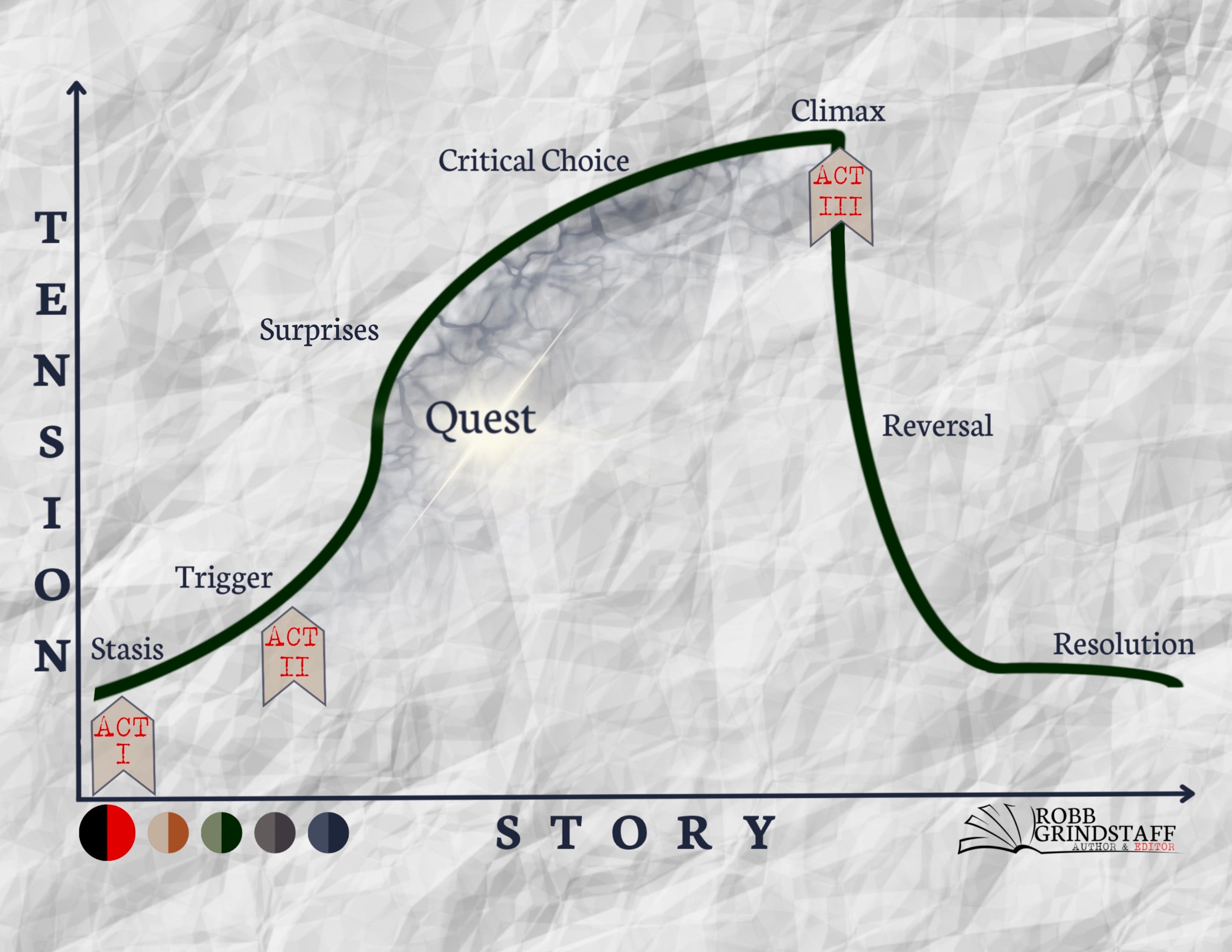
Graphic illustration by Lauren Mckinnon
Does the tension grow from stasis to climax, even with small points of declining tension along the way, and hit that ten-mark in the climactic scene?
Your trigger might take it up several notches. It might stay there for a bit before it rises higher, then drops a bit to give the character and readers a breather.
How long does it stay in this declining tension state? Is that too long? Readers will get bored.
How far does the tension drop? Is that too far? That can feel like the story has resolved and there’s still 200 pages to go.
Evaluate and analyze
Questions to ask yourself:
Does the tension rise appropriately, at the right points, and in a way that will keep readers turning the pages to find out what happens next?
Does the stasis go on too long before the trigger?
Or, does the trigger happen too soon, before readers are grounded in the situation and have connected with the character?
Does the trigger engage the reader strongly enough to stick with the rest of the story?
Do the surprises come at the right points and raise tension on a progressively higher level?
Are there moments of declining tension at just the right point to give the character a moment to plan or process emotions, while also giving readers a moment to catch their breath?
Do those declining moments take the tension down too far or for too long?
Do the surprises along the way lead to the critical choice in a logical progression?
Is that critical choice scene the highest point of tension in the book to this point?
Does the climax take that high-tension moment and drive it to the pinnacle?
Do the reversal and resolution scenes (or scene) bring tension down in a satisfactory way that feels complete?
Do those final scenes go on too long?
Or are they too abrupt?
Analyze all these points of tension and jot some notes on areas that need work.
Then we’ll come back to your outline and notes with another area to think about next week.
Summary
Overlay the eight-point narrative arc on your scene-by-scene outline
Evaluate each scene and where it falls in narrative arc
Analyze the rising and falling tension of each scene
Map out that tension on a chart, if you find that visual helpful
Next week: story structure
In Part 4, we’ll take this outline (scene-by-scene overlaid with narrative arc) to look at the underlying story structure
Evaluate if the book is structured in the best manner for the story being told, and look at other options available
Books by Robb Grindstaff
Newest release: St. Izzy of F Street — Now on Substack


"Watch for the declining tension scenes dragging on so long that readers will get bored, leaving them with a more negative impression of your book than they’d had twenty pages earlier."
Uggh, I just finished reading a book that did just that. It kind of soured me on a story that I had otherwise thoroughly enjoyed. You have to wonder how an editor didn't catch that. Great advice as always, Robb.